Friday, 17 July 2015

A matter of life and death


Paracas peninsula
photograph - Manuel Medir

©PromPeru 

In 1924 Julio C. Tello and the North American archaeologist Samuel Lothrop travelled to a secluded coastal peninsula a few hours south of Lima. There they found a landscape ravaged by looters. The ground was pitted with holes. Anything the tomb robbers had deemed to be of no value had been tossed aside. Human remains, pottery shards and scraps of textile lay strewn across the desert.

Tello and Lothrop carefully gathered up as much as they could salvage, piling it all into a truck bound for Lima. The return trip coincided with one of the heaviest rain deluges ever recorded in the area, turning the journey into a veritable adventure. The vehicle with its gruesome burden advanced slowly along roads which, at the best of times were rudimentary, but had now turned into a quagmire of sodden sand. This was to mark the beginning of one of the most important finds in Peruvian archaeology - the discovery of the Paracas culture.

A year later Tello was back, with his assistant Mejía Xesspe. Over the next four years excavations uncovered a series of bottle-shaped tombs, and a steep slope crowded with conical funerary bundles.  


fig 1


The discovery was extraordinary, eventually yielding up more than 400 funeral bundles - fardos. The textiles that wrapped the bundles were startling; finely woven and embroidered with complex designs representing geometric designs, humans and mythical animals. The colours were still brilliant, having been almost perfectly conserved in the desert environment.These textiles are now known as some of the finest ever produced in pre-Columbian societies.

The materials were all carefully logged before being packed in straw and jute sacks for transportation to Lima, where Tello, Hernan and the rest of the team began the immense and intricate task of opening and cataloging the bundles.

photo - MNAAHP

But there were scant resources to deal with this major find, and once the bundles had been removed from the dry desert environment that had kept them for so long, it was a battle against time. Tello was always fighting the system – struggling to get the funds and personnel he needed to effectively conserve and document the material.

In this story. Hernan describes how Tello had no qualms about going straight to the top to get a job done.  He’s not adverse to a little clever strategizing either, using his success at another site just outside Lima, Pachacámac, to lobby for funds.

Happily he was successful. This is just the beginning of the story, but the Paracas funeral bundles eventually became the flagship collection of what is today Peru’s National Museum of Archaeology, Anthropology and History.

On my most recent visit to Pachacámac the earth moved for me (literally) but that's another story. Hernan is writing over half a century ago and he flags up an issue here which is increasingly relevant today. Pachacámac survives relatively intact, but many of Lima’s lesser known huacas have fallen foul of urban spread. Fragile sites have been lost forever to blatantly uncontrolled construction.

And the question of access looms large over Peru’s most famous monument Machu Picchu. How long before visitor numbers begin to cause serious issues for the site’s survival and integrity?


A matter of life or death
In which Tello goes in to bat with the big boys for his beloved museum


The museum needed more room. Of course we would never get as much as Tello wanted, but for sure we needed more than the new government building project would provide.
fig 2

We had more than three hundred Paracas mummies stored at the museum; many of which were extensively wrapped, and their beautiful cloaks, along with everything else, were slowly deteriorating in Lima’s humid conditions.  It was essential that we unwrap and study them as soon as possible.

Friday, 10 July 2015

The governor of Huantán

Great excitement and pride recently over Peru's impressive performance during the Copa America. 

And then an additional stirring moment when captain and Bayern Munich striker Claudio Pizarro became the first player in the tournament to tweet in Quechua.


Pizarro told El Comercio that he had to get help from the internet, his team mates and the team’s physio to post the messages. “I would have liked to have learned it in school, and have it. But it helps at least to get people excited and fired up. And at the same time we help keep it alive – not to lose this language that is ours.”

Quechua is one of Peru’s official languages, along with Spanish, and is still spoken by about 3.5 million people, mainly in the central and southern Andes. It’s only one of the country’s indigenous languages - there’s also Aymara from the southern plains of Puno and Lake Titicaca, and other lesser known languages from the Amazon region.

Although these languages are starting to be recognized more, they are struggling to survive as people move from the country to the larger cities and the coast where Spanish is dominant.

Tello’s knowledge of Quechua was a huge advantage in his work. It wasn’t only about uncovering artefacts. It was all about the people. There’s a strong sense of this in tio Hernan’s Anecdotes. For them the excitement was in the stories those treasures could tell about the past and how those stories resonate down the generations to form a living link in the indigenous populations.

Tello’s enthusiastic investigative approach was apparent from early on. Hernan describes the scientist’s first field trip as a young student


The governor of Huantán
In which three students excite considerable suspicion in Yauyos

The young Tello was twenty years old and in the second year of his studies when, under the guidance of his professor Sebastián Barranca, he organized his first anthropological field trip. He chose the province of Yauyos, so that he could study the cauqui language, along with the flora, fauna and folklore of the region.

Thursday, 2 July 2015

Banquet at the Maury

As I write today temperatures are moving on up into the 30s here in Lisbon. Time for one of my all-time favourite summer cocktails - Chilcano de Pisco.

Pour a good large measure of Pisco (about 50ml) over plenty of ice cubes in a tall glass, add a squeeze of lime juice (about a tablespoon), a splash of Angostura bitters, and top it all up with ginger ale. Have fun playing around with the measurements if you like, but I have it on good authority that it’s all in the order of ingredients in the glass.


photo - El Comercio

Pisco Sour is the better known classic Peruvian cocktail, and some years ago I went to the bar at the Hotel Maury to research the lineage of this most cherished lovechild of Peruvian culture. 

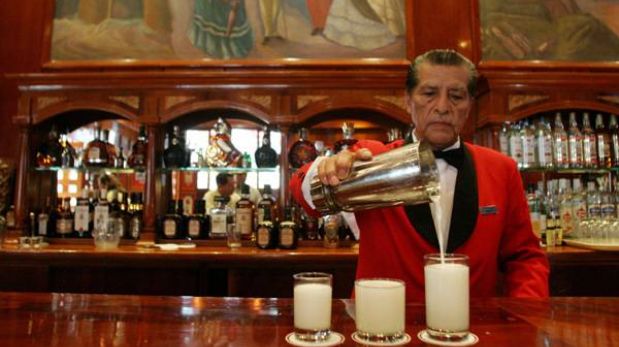
If I’m honest it was a chance to just hang out in this coolest of cool bars in the heart of downtown Lima on a dusty Sunday afternoon. But I was also lucky enough to watch a master at work. Señor Eloy Cuadros Cordoba has worked at the Hotel Maury for more than half a century. The full interview, complete with Señor Cuadros' tips for the perfect Pisco Sour, is here. 


Señor Eloy Cuadros Cordoba doing what he does best behind the bar at the Maury
photo - el Comercio
fig. 1
It’s a Californian import, Victor Morris, who is widely credited as having invented the original Pisco Sour. He worked in the mines of Cerro de Pasco where he ran a gaming house. The story goes that with no whisky to hand to make whisky sours, he replaced it with Pisco. He later opened the Morris Bar in Lima. But Morris was a consummate gambler. He went bankrupt, had to close the bar, and some of his employees then moved to the Hotel Maury.


The Posada de Pedro Maury existed since the days of independence. General San Martin himself stayed there, as well as Miguel Grau. Later the posada was refurbished and modernized and in 1848 became Lima's first great illustrious hotel - the Hotel Maury.

Today it is a rather prosaic 1954 version of the original. Needless to say it has lost much of its former grandeur, but the bar is still splendid and proclaims to be the birthplace of the Pisco Sour as we know it. 

As Cuadros, the resident, charismatic barman will testify, his clientele is now a mixed bunch of professionals and tourists, although the Maury still sees the odd diplomat or two popping in from the Ministry of Foreign Affairs just up the road.


photo - citiHeartBeat
I had also gone to the Maury because of this story that I found in the Anecdotes. 

Tio Hernan makes it clear that back in the day, the Maury had clout; home to a glittering array of politicians, business men, and the social elite. 


Peru’s devastating loss to Chile in the War of the Pacific (1884), and the country’s ensuing bankruptcy spawned a group of young intellectuals who questioned what had happened, what had gone wrong, and more importantly addressed the issue of what needed to happen now. How was Peru to emerge and develop and move forward?  They are known as la generación de los 900 (900 is short for 1900’s), and they were the emerging thinkers of the new twentieth century.

Victor Andrés Belaunde, Raul Porras Barrenechea, José de la Rivera Agüero, Francisco Garcia Calderón -the journalist, writer and diplomat who Hernan describes here returning to Peru after his postings abroad. These are all names that resonate in Peru still today.

They all gathered at the Maury and they were, as Hernan points out here, all white.


Banquet at the Maury
In which Tello appears on the radar of Lima's society elite

If all the anecdotes from the Hotel Maury could be compiled, we would have a fascinating record of the many subtle nuances of our nation's story. So many of the men, in so many diverse fields, who helped trace the route of our country's history have passed through those doors

On this occasion, none other than, the famous Peruvian philosopher and writer, Francisco Garcia Calderón had just arrived in Lima from Paris, and his friends wanted to organize a banquet in his honour. Naturally it would be in one of the city’s most luxurious and prestigious locales … the Maury.

Tuesday, 16 June 2015

The sorcerer

Tello the archaeologist didn’t start out on that path. He initially wanted to be a doctor, and studied medicine at San Marcos University.

In 1908 he presented his thesis on the antiquity of syphilis in Peru to great acclaim. Indeed according to tio Hernan, it was the first time in the history of Peruvian medicine that a student had graduated with such high distinction.

It was this scientific grounding that later inspired in him the methodological approach to archaeology which he became famous for.  And it was obvious even at this stage that this young man from the mountains was destined for success.

But not to everyone …..


fig 1
                                                                                                                                 

The sorcerer
In which the upstanding residents of Comesebo Street become convinced they are harbouring a dangerous psychopath


The tenants in the alley just off Comesebo Street were adjusting to the presence of their rather strange new neighbour. The young man had not made friends with any of them and so no-one knew anything of his occupation or his pursuits. All they knew was that he left very early in the morning and arrived late at night. And they noticed that he was always carrying a load of books under his arm. It was the books that most exasperated some of the local Limeños, who were of the opinion that this serrano was trying to get ahead of himself.

And then something happened that led them to the conclusion that he wasn’t a student at all.

Thursday, 21 May 2015

Poor but not quite destitute


the old Peruvian National Library building
as portrayed on the back of a hundred soles banknote

Traffic in Lima is unquestionably brutal. Driving is a cut throat business that, if you’re not too worried about your blood pressure, can be quite exhilarating, requiring aggression and creativity in equal parts.

The last time I was living there, I was passenger in a taxi which got involved in a bit of a fracas in the street. Needless to say heated gestures ensued, and as the taxi driver drove off he spat out one word at the other motorist ….  serrano.

He nodded and smiled knowingly at me in the mirror. But I chose to remain silent in the back. Serrano, of course, means someone from the mountains.

There’s no doubt that things are far different now from the times when tio Hernan was writing his Anecdotes. But for me words tell stories, and the traffic incident was testament to a society still grappling with the lingering subtleties of racism and inclusion.

Tello was a mountain Indian who overcame financial difficulties and social obstacles to reach the position he did. He was a fierce advocate for indigenous communities, and I think his single minded refusal to be intimidated by the coastal elites of the time is a large factor in the legendary status he holds today for some Peruvians.

The rags to riches angle is inspiring. But in this story Hernan, who was himself from the central Andean highlands, takes issue with what he sees as a somewhat patronising portrayal of his hero. And reminds his readers that the concepts of money and position then, as now, can often be relative.


Poor but not quite destitute 
Wherein we learn of the reason for Tello's brief accomodation crisis and his subsequent rescue by an eminent Peruvian historian

Two days after Tello’s death there appeared an article in La Tribuna under the title Julio C Tello, Illustrious Amauta. I believe it’s possible that this article has been the source of some resulting biographies grossly overstating Tello’s supposed penury.

Thursday, 14 May 2015

Point of departure


photograph by José Alva
©PromPeru

Hernan’s 50 Anecdotes del Sabio Tello don't only tell the stories of the expedition team's adventures around Peru in the 1930s and 40s.  Several of them also tell the story of Tello himself. 

How did this boy from the mountains come to be 'arguably the greatest Native American social scientist of the twentieth century'?*


Point of departure
In which we find our where it all began for Tello

Scattered all over Peru are the chulpas of our ancestors. The burial towers and chambers where ancient Peruvians lie swallowed up in their eternal slumbers are where today’s farmhands, shepherds and animals continue to find shelter.

Many of them lie so far off the beaten track that they are never visited. One of these sites, Chuicoto in Huarochirí, was where the young Tello used to hide himself away and play as a small boy. 

Wednesday, 6 May 2015

A meagre harvest

If you're reading this in the UK this week, the mere mention of politics will probably be enough to make you slam shut your laptop. All I can say is good luck to you all tomorrow.

Peru doesn't go to the polls until May 2016, but already seems set for the usual tumultuous year of electioneering nonsense. Get ready to jump aboard the magic roundabout.

All this by way of forging a (somewhat tenuous)  link to this latest story from the Anecdotes. Land rights I suspect haunt the dreams of many a Peruvian politician. It's a complex issue, with no easy fix guaranteed to unravel the fearsome web of conflicting interests. That said - no reason not to try.


In this story. Tello's assistant Mejía Xesspe bigs himself up and poses as a special government envoy in an attempt to track down some ancient artefacts. In the process he gets caught up in the brouhaha between two provincial warring factions.


A meagre harvest
In which we see what happens when the gloves come off in a rural community in Andahuaylas


Tello had always been really fascinated by the Inca quero. So it was with great excitement that one day in October 1925, his devoted follower Toribio Mejía Xesspe, reported that he was on the scent of a trail that promised to uncover some. There ensued a saga that Tello always delighted in recounting to us with great amusement.